
Nourishment

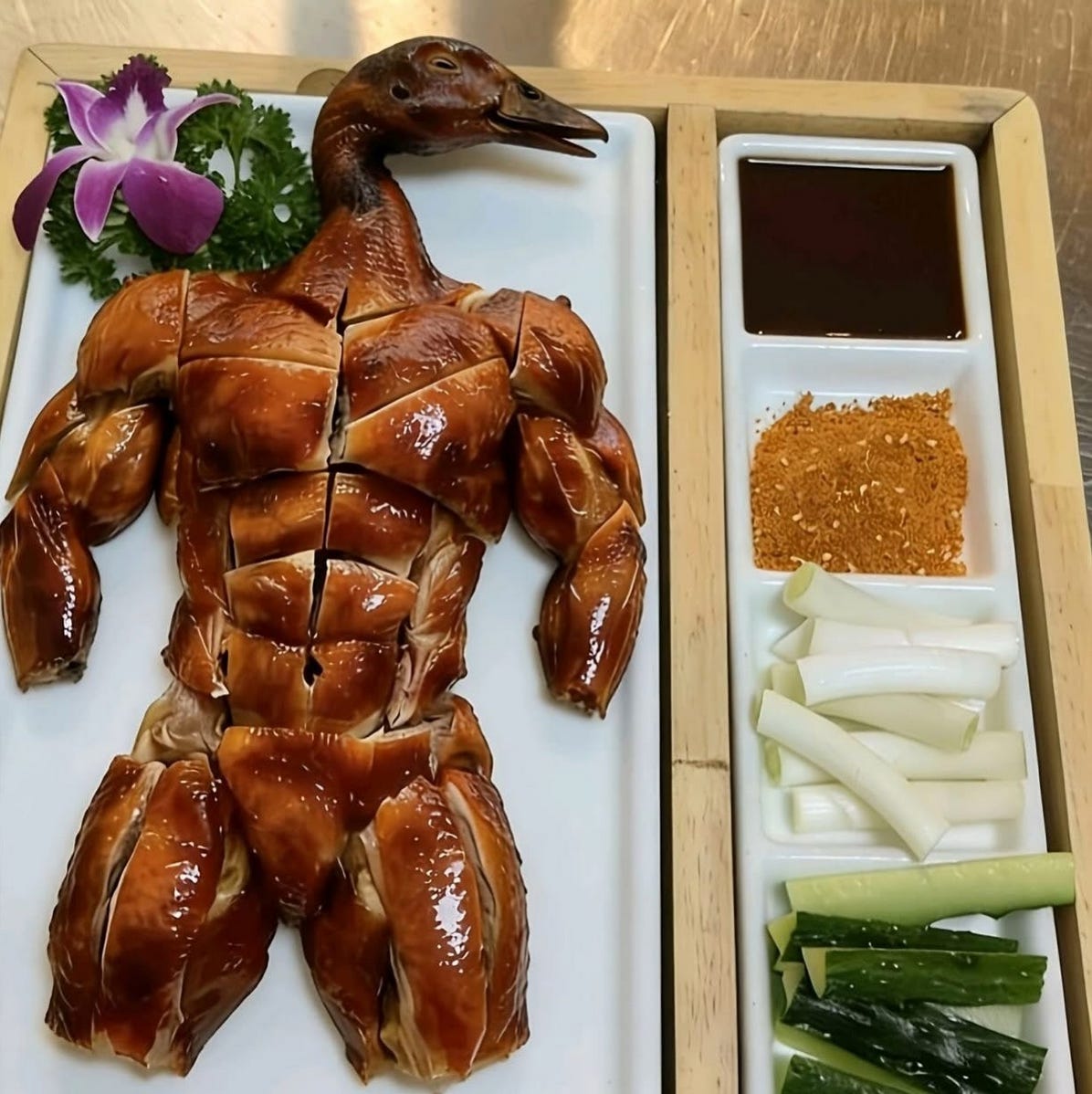
What the Duck?!?
Is it nightmare fuel or culinary fine art? That’s the polarizing response I got from friends when I shared an image of a duck, prepared by Qi restaurant at the Ritz-Carlton in Beijing, China to resemble the physique of a bodybuilder. This Peking duck, a traditional Beijing delicacy, features prominent pectoral (pun intended) and other well defined muscles.
The conceptual meal alludes to duck’s high protein content and other beneficial nutrients, and acts as a symbol of the restaurant’s quality. It suggests that this is a dish that’s physically fit to eat.
Consuming protein rich foods among a balanced diet is a foundational element of fitness training. When we work out we’re creating microscopic tears in the muscles, which are repaired and built back stronger during periods of recovery, and with a good diet and sleep routine. Pumping iron signals the body to engage in muscle hypertrophy, but muscle is made in the kitchen.
Eating well has different implications for different individuals. The best thing to do if you’re struggling or concerned about your diet is to consult a licensed nutritionist; and not take advice from random and unqualified social media influencers.
There are a number of reasons why folks have complex relationships with food. At its core, nutrition shouldn’t be a daunting, exclusionary and controversial concept. There’s a major problem of food and body shaming in the fitness and wellness industry. Shaming anyone about food and activity choices is counterproductive. You may think you’re offering “tough love,” but (often unsolicited) snide comments about what someone eats and does physically, can do far more harm than good. Someone who is struggling to eat due to an eating disorder or physical ailment does not need you telling them what (in your opinion) “good food” and “bad food” is, they simply need to eat.
I’ve had recurring issues with eating disorders and body dysmorphia, which I’ve written about several times on this platform. One of the biggest things that has helped alongside therapy to find the root reasons for my eating disorder, was my development into a self-proclaimed foodie. I eat to live, and also live to eat. Enjoying the fruits of our culinary labor is a privilege that is unique to the human condition. Cultural traditions are a significant reason for eating and enjoying food. Meals are sustenance for more than the body when consumed this way, because they become social, emotional and intellectual nourishment as well.
Food, like visual art and education, is a gateway to cultural understanding and appreciation. The culinary arts foster dialogues about our unique and collective identities in an empowering setting. And the plurality and potency of this cultural exchange is why food has been a popular medium for artists. The list of artists utilizing food production, distribution and/or sharing meals is extensive. It includes Gordon Matta-Clark, Michael Rakowitz, Briana Calderón Navarro (Collective Focus), Heather Hart and Jina Valentine (of the collective Black Lunch Table), Rirkrit Tiravanija, Alison Knowles, Jen Catron and Paul Outlaw and Mary Mattingly (Swale).
Labeling food using binary terms (i.e. ‘good’ vs. ‘bad’) ignores the other vital aspects that are associated with it. Rather than admonishing people for how and what they eat, it’s fruitful to embrace a nuanced understanding of why they are eating that way, which includes mental health, physical health, cultural identity and food insecurity.
A balanced diet includes individual needs, tastes and preferences. If you’re looking for advice, seek the professional services of a Registered Dietitian Nutritionist; but don’t let anyone make you feel guilty, or impose their morality around what and how you eat.
Thanks for reading Artfully Exercising!
Show me some ❤️
I’d be grateful if you’d take a moment to hit the “heart icon” on this post to show your appreciation (and boost this post within the algorithmic sea that is social media).
Consider subscribing 📩
Artfully Exercising is a reader-supported publication about art and fitness. To receive new posts and support my work, consider becoming a free or paid subscriber:
Documenting my physical and mental health journey, and providing y’all with exercise experience in the form of Artfully Exercising has been a labor of love. It takes a lot of (well spent) time, energy and resources to write the content you receive in your email boxes. If my writing has given you any sort of inspiration and enrichment, please consider making a contribution by becoming a paid subscriber or making a one time contribution.
If you are not ready to become a paid subscriber, you can support my work with a one pledge at a monetary value of your choice:
Let’s continue the conversation 💬
If what I’ve written resonates with you, and/or you want to share your thoughts, please leave me a comment! One of the most rewarding things about writing is getting feedback and making connections with others!
Hi Adam, My daughter and her partner recently cooked duck breasts to expand their culinary expertise. My daughter is a personal trainer and told me duck is full of good nutrients. Who knew? Many thanks for sharing.
I love the article and your points highlighting cultural identity as part of our food preferences, but I want to point out that contrary to one of your points, "enjoying the fruits of our culinary labor" is NOT unique to humans. Gorillas have been known to intentionally eat certain leaves together in a curated bite because they enjoy the combined flavors.
Additionally, orcas have fads of wearing salmon hats. I wonder if you would consider this to be a culinary art?